
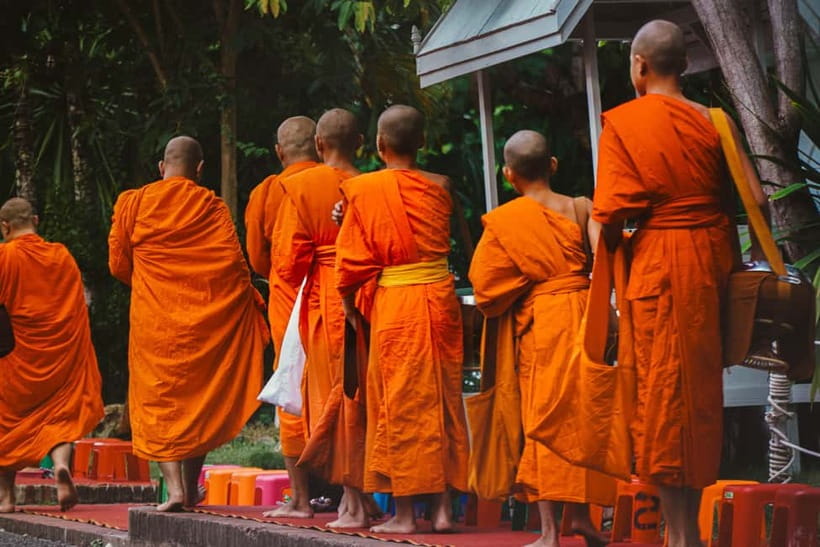
Reviewed · LUANG PRABANG TOURS
Luang Prabang: Almsgiving Ceremony Offering
Wake before sunrise for a quieter Luang Prabang. This one-hour experience gives you a respectful way to see Tak Bat, the daily morning almsgiving ceremony, while learning why locals offer sticky rice and food to saffron-robed monks. I like the ready-made offering set and the chance to visit a nearby temple afterward. I also like that the meeting point near Wat Nong can place you on a quieter side street, away from the largest crowds. The main concern is reliability: two people reported that they could not find the guide or that the guide did not arrive.
The $25 price feels fair if you want cultural context rather than a quick photo stop. Guide Johnny received especially warm praise for explaining Buddhism and monastic life, with one person noting that he had spent ten years as a monk. Still, this is not a full city tour, transport is not included, and the experience lasts only about one hour.
In This Review
- Key details before you book
- Why Tak Bat matters in Luang Prabang
- Starting at L’Elephant before sunrise
- Preparing your traditional offering
- Taking part without turning it into a photo stop
- The nearby temple visit after Tak Bat
- How good is the guide support?
- What the $25 price gives you
- Who will enjoy this morning best?
- Small details that make the morning easier
- Should you book the Luang Prabang almsgiving experience?
- FAQ
- How long does the almsgiving experience last?
- What is the starting location?
- Is transport included?
- What food is provided for the offering?
- Is a scarf provided?
- What should I wear?
- Can I take photographs?
- What languages are available with the guide?
- Can I cancel the booking?
Key details before you book
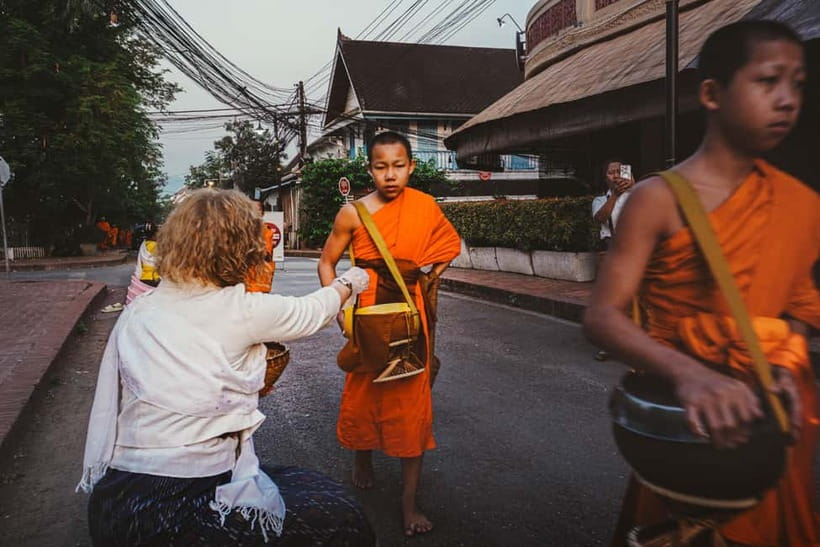
- Tak Bat takes place at sunrise: You will need to begin very early, but the quiet streets and soft morning light suit the ceremony.
- The offering set is included: Sticky rice, bananas, and snacks are provided, so you do not need to shop for food before dawn.
- A scarf is supplied for the ceremony: You can also bring your own scarf, which helps with modest dress and local etiquette.
- Johnny may be your guide: He has been praised for explaining Buddhism and for his past as a monk, though guide reliability has not been perfect.
- Wat Nong offers a quieter meeting point: The side road near the temple can feel calmer than the main almsgiving route.
- The price is $25 per person: Free cancellation up to 24 hours before the start and pay-later booking add useful flexibility.
Why Tak Bat matters in Luang Prabang
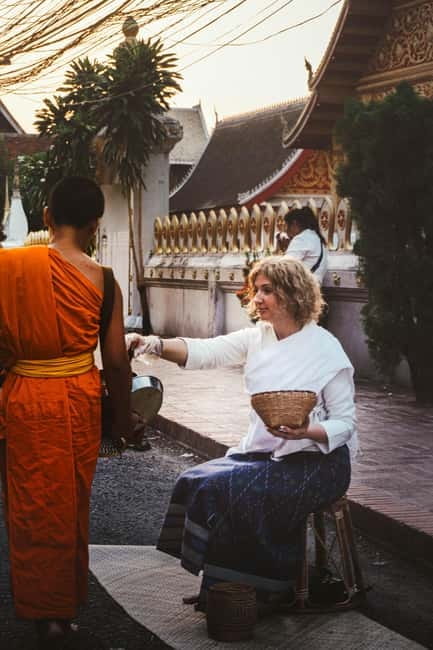
Tak Bat is not a staged show created for sightseeing. It is a daily religious practice in which Buddhist monks walk silently through the streets while local people place food into their alms bowls. The ritual links the town’s residents with its monasteries, and the silence is part of what gives the morning its special mood.
Your role is simple but important. You sit or kneel at the roadside, prepare a small portion of sticky rice or another offering, and place it into the bowl as a monk passes. You do not touch the monks or their bowls. You also need to keep your voice low, avoid sudden movement, and leave flash photography at home.
I like this format because it gives you enough explanation to avoid treating the ceremony as a photo opportunity. The supplied guidance on respectful behavior is valuable, especially if this is your first visit to a Buddhist town. You are not simply watching a line of monks pass by. You are learning how to take part without interrupting the practice.
More almsgiving and temple mornings:
- Luang Prabang: Pottery Workshop & Wat Chomphet cycling Tour
★ 4.6 · 5 reviews - Luang Prabang Early Morning Alms Giving and Wet Market
★ 4.5 · 5 reviews - Pakse: Mystic Falls & Timeless Temples of Southern Laos Tour
★ 4.6 · 21 reviews
Starting at L’Elephant before sunrise
The listed starting point is L’Elephant, with the activity beginning in the early morning. The information does not give a precise meeting time, so check the start time carefully when you book and arrive early. Sunrise activities are not forgiving of late arrivals, and the ceremony itself moves along the street rather than waiting for a group.
The early hour is part of the appeal. Luang Prabang feels calm before the day gets going, and the low light creates the serene setting promised by the experience. You may see long lines of saffron-robed monks collecting sticky rice, bananas, and other food as they move silently through town.
One practical issue deserves attention. Transport to the ceremony spot is not included. You need to make your own way to the meeting point. Since the activity is only one hour, add enough time to get from your accommodation to L’Elephant or the confirmed meeting location. The meeting instructions should be clear, but the two reports of missed guides make it wise to confirm the details before setting out.
Preparing your traditional offering
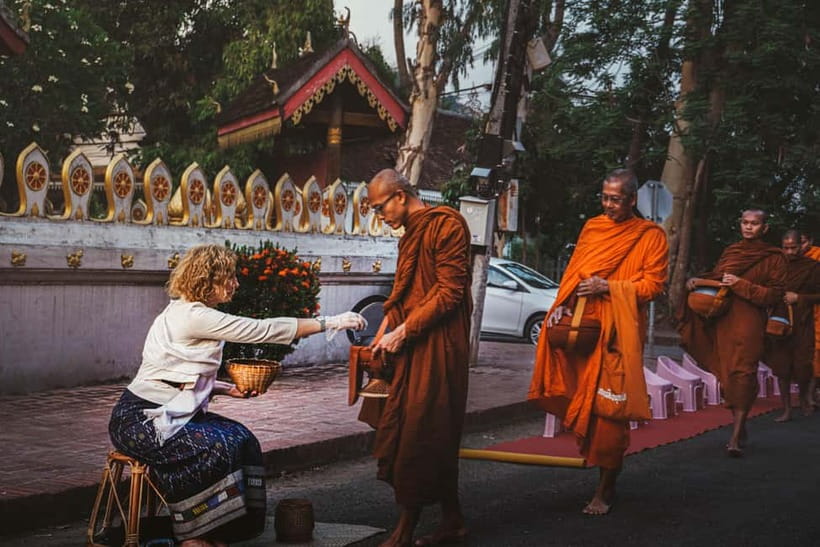
The price includes a traditional Lao offering set with sticky rice, banana, and snacks. This is a useful touch. You do not have to search for a vendor in the dark, guess what to buy, or worry that you have prepared the food in an unsuitable way.
The offering is more than a convenient prop. Sticky rice is a familiar part of Lao food culture, and placing it into a monk’s bowl lets you take part in the act rather than remaining at a distance with a camera. Your guide is expected to explain the basic customs, including how to behave and when to offer the food.
A local-style scarf is also provided. You should dress modestly before you arrive, with shoulders and knees covered, but the scarf gives you another way to meet local expectations. The official advice also says to bring a scarf, so I would treat the supplied item as useful backup rather than your only plan.
Keep the offering tidy and follow the guide’s instructions. Do not reach toward a monk, touch a robe, or handle an alms bowl. If you are unsure what to do, it is better to watch one person nearby and wait for guidance than to improvise.
Taking part without turning it into a photo stop
The ceremony can produce beautiful images, especially in the gentle morning light. Still, your camera should remain secondary. Flash photography is not allowed, and a bright burst would disrupt the quiet mood for everyone nearby.
I recommend taking a few photographs before or after your offering, then putting the camera away while the monks pass. You will notice more when you are not trying to frame every moment. The experience description encourages serene photographs, but its etiquette rules make clear that respect comes first.
One person specifically praised Johnny for taking good pictures during the offerings. That can be helpful if you want a record of the moment without juggling a camera while participating. Do not assume this is guaranteed, however. The included information promises respectful guidance, not personal photography for every participant.
The best approach is restrained. Avoid stepping into the monks’ path, do not use flash, and do not ask monks to pose. The ceremony works because it remains quiet and focused. Your presence should fit into that setting, not reshape it.
A different idea for your next Laos day:
- Luang Prabang: Cruise to Pak Ou Caves & Kuang Si Waterfalls
★ 5.0 · 1,769 reviews - Luang Prabang: Cruise to Pak Ou Caves & Kuang Si Waterfalls
★ 4.8 · 1,360 reviews - Half Day Mekong Cruise to Pak Ou Caves (Morning / Afternoon)
★ 4.6 · 290 reviews - Luang Prabang: UNESCO World Heritage City Highlights Tour
★ 4.6 · 201 reviews
The nearby temple visit after Tak Bat
After the almsgiving ceremony, you visit a nearby temple for more context about Buddhist practice. The starting information points to Wat Nong as a meeting area, and one person especially liked meeting on a quiet side road near the temple, away from the general crowd.
This second part gives the morning more meaning. Without it, you might see the offering ritual and leave with only a handful of photographs. At the temple, you have a chance to connect the ceremony with monastic traditions and the wider role of Buddhism in Luang Prabang.
The temple visit is still brief because the full activity lasts one hour. You should not expect an extensive temple tour or a long lesson in Lao religious art. What you get is a compact follow-up that can help explain what you have just witnessed.
Johnny’s background may be a real benefit here. Several high ratings praise his explanations of Buddhism, and one German participant noted that he had been a monk for ten years. Another person described him as thorough when discussing monastic tradition. That kind of personal experience can make a short temple visit more useful than a general script.
How good is the guide support?
The experience is advertised with a live guide in English or Thai. This is important because the activity is not simply a self-guided chance to watch monks pass. You are paying for cultural explanation and help with respectful participation.
Johnny received the strongest praise in the supplied comments. He was described as excellent, professional, and able to explain the ceremony and Buddhism clearly. A Spanish participant also appreciated his help with photographs. If Johnny leads your departure, his former monastic life could add useful detail that you would not gain from observing alone.
There is, however, a clear weakness in the record. Two people gave one-star ratings because they could not find the guide or did not receive contact, with one person walking through the ceremony alone after paying. That is not a small inconvenience for a one-hour sunrise activity. If nobody appears, much of the value disappears.
The safest plan is to confirm the meeting place and contact information before bed. Keep your phone charged, arrive at the named location early, and do not wander far if the guide is late. The experience has earned a 4.1 rating from 13 ratings, so the overall picture is positive, but the no-show reports deserve attention.
What the $25 price gives you
At $25 per person, this is a modestly priced cultural activity. The fee covers the traditional Lao offering set, the scarf, local guidance on etiquette, the ceremony, and the nearby temple visit. You are also buying a little structure at an hour when independent planning can be awkward.
The value depends on what you want. If you only need a place to watch Tak Bat, you could find the ceremony without booking this activity. The paid option makes more sense if you want food supplied, help with the ritual, and an explanation of Buddhist practice.
The short duration keeps the cost from becoming a major commitment. You can fit it into a morning of sightseeing, and the pay-later option means you do not have to pay at the time of booking. Free cancellation up to 24 hours before the start gives you some protection if your plans change.
The drawbacks are just as clear. There is no transfer, and the guide is not described as providing step-by-step assistance throughout every moment. You also pay for a one-hour activity, so a missed meeting would be especially frustrating. I would call the price good value when the guide arrives and provides the promised context, but less attractive if you are comfortable handling the ceremony alone.
Who will enjoy this morning best?
This suits you if you want a short introduction to Luang Prabang’s religious life and prefer to participate with guidance. It is also a good match if you want the practical ease of a prepared offering set rather than buying food before sunrise.
You will likely appreciate it most if you are willing to follow local rules. Modest clothing, quiet behavior, no flash, and no touching are not optional extras. The activity is not designed for people who want a lively, chatty group event or a long sightseeing tour.
The experience may also suit photographers who can work without flash and accept that the ceremony comes before the picture. The supplied guidance says to bring a camera, but the atmosphere calls for restraint. A few thoughtful images are more suitable than constant shooting.
It is wheelchair accessible according to the activity information. Babies under one year are not considered suitable, and the listing also excludes people with altitude sickness. Luang Prabang is not presented here as a high-altitude destination, so if that warning applies to you, follow the provider’s restriction rather than dismissing it.
Small details that make the morning easier
Wear clothing that covers your shoulders and knees from the moment you leave your accommodation. Bring a camera if you want one, but turn off the flash, and carry your own scarf even though one is supplied.
Do not arrive carrying expectations of a large program. The published plan is compact: meet at L’Elephant, see the sunrise ceremony in Luang Prabang, and visit a nearby temple. The scenery on the way is part of the morning, but no transfer is included.
English and Thai are the stated guide languages. If you need detailed cultural explanations, make sure you select a language you can follow comfortably. The most praised guide, Johnny, is particularly associated with clear explanations of Buddhism and monastic life.
Finally, allow a little patience around the meeting. The no-show reports mean you should keep the provider’s contact details available. That is not a reason to reject the activity, but it is a good reason to prepare carefully.
Should you book the Luang Prabang almsgiving experience?
I would book it if you want a respectful first look at Tak Bat, need the offering supplied, and value a guide who can explain Buddhist practice. The praise for Johnny is unusually specific, especially his former ten years as a monk and his clear explanations. Meeting near Wat Nong on a quieter side road could also make the ceremony feel less crowded.
I would skip it if you only want to watch from a distance, already understand the ritual, or need guaranteed door-to-door transport. I would also think twice if you cannot confirm the meeting arrangements before the early start.
For most visitors, the decision comes down to context. The monks and the morning ceremony are the heart of the experience, while the food set, scarf, guide, and temple visit make participation easier. At $25, that is a fair trade, provided the meeting works as planned and you treat the ceremony as a living religious practice rather than a performance.
FAQ
How long does the almsgiving experience last?
The experience lasts one hour, including the morning ceremony and a visit to a nearby temple.
What is the starting location?
The stated starting location is L’Elephant. Confirm the exact meeting instructions and starting time when you book.
Is transport included?
No. Transfer to the ceremony spot is not included, so you need to make your own way to the meeting point.
What food is provided for the offering?
A traditional Lao offering set is included. It contains sticky rice, a banana, and snacks.
Is a scarf provided?
Yes. A local-style scarf is provided for use during the ceremony. You are also advised to bring a scarf.
What should I wear?
Wear modest clothing with your shoulders and knees covered.
Can I take photographs?
Yes, but flash photography is not allowed. You must also avoid touching the monks or their alms bowls.
What languages are available with the guide?
The live guide languages are English and Thai.
Can I cancel the booking?
You can cancel up to 24 hours in advance for a full refund. A reserve-now-and-pay-later option is also available.
Just added around Luang Prabang
- Private Luang Prabang City Tour★ 5.0 · 3 reviews
- A Relaxing Day at the Kuang Si Falls★ 4.5 · 3 reviews
- Luang Prabang Night-time Explorer★ 3.5 · 3 reviews
- Luangprabang: Dinner with Lao Traditional Dance Performance★ 4.0 · 3 reviews
- Sunset Cruise in Luang Prabang with Live Performance★ 4.5 · 3 reviews
- Luang Prabang Private Full-Day Tour and Lunch★ 4.7 · 3 reviews
- Luang Prabang: Local Village & Kuang Si Falls Private Tour★ 4.9 · 3 reviews
- Luang Prabang: Mekong River Cooking Class with Hotel Pickup★ 5.0 · 3 reviews
Luang Prabang Tours, compared.
Luang Prabang: Cruise to Pak Ou Caves & Kuang Si Waterfalls
Read our review →
Half Day Mekong Cruise to Pak Ou Caves (Morning / Afternoon)
Read our review →
Luang Prabang: UNESCO World Heritage City Highlights Tour
Read our review →
Luang Prabang: Afternoon Kuang Si Waterfalls & Sunset Cruise
Read our review →
Luang Prabang: Evening Cooking Class & Local Baci Ceremony
Read our review →
Luang Prabang: Bamboo Weaving Workshop & Cooking Class
Read our review →
Browse the lists this tour appears in